Issue one
- – Welcome from Michèle Taylor
- – On The Road with Ramps on the Moon
- – Change Partner news and feedback from our cohort of cultural senior leaders
- – Audio Diaries of a Change Partner – real-time feedback of their journeys
- – Opinion piece: Does the word ‘Access’ belong in the Social Model of Disability?
- – A Framework for Anti-Ableist Organisations
- – Ramps on the Moon Podcast – Now is your moment!
- – The Dilemma Desk – Your space for sharing challenges and frustrations
- – The Ramps on the Moon Resource Hub
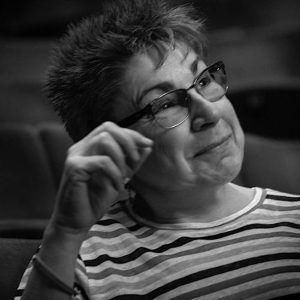
Welcome from Michèle Taylor, MBE, Director for Change

Welcome to our inaugural edition of The Shift, the quarterly newsletter you won’t want to miss if you are serious about anti-ableism in the arts. In this issue, we will tell real stories of anti-ableist practice, ask hard questions, share ideas and resources, and disrupt received wisdom.
Let us know what you think of The Shift, contact us if you have a question for our ‘Dilemma Desk’, and look out for the next edition coming in March 2026.
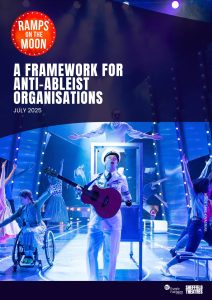
In this edition we’re sharing a link to our Framework for Anti-Ableist Organisations in case you haven’t seen it. This document sets out a model of understanding how an organisation can move from a place of ‘Disability Awareness’ to Anti-Ableism through Access and Disability Equality. There are examples of actions and approaches in each phase and an exploration of why anti-ableist practice is what cultural organisations should be aiming for.
And finally, I’ve written a short opinion piece, asking the question, ‘‘Does the word “Access” belong in the Social Model of Disability?’ I’d love to know your thoughts.
Thank you so much for joining us and if you haven’t subscribed yet – please do so HERE
Michèle
On The Road!
It’s been a busy time in the life of this Director for Change. In the last couple of months, I’ve travelled to London, Bury St Edmunds, Exeter, Rotherham, Ipswich, Birmingham, Stratford-upon-Avon and spent a glorious cold and sunny few days in Helsinki.
I’ve been mentoring an integrated disabled and non-disabled company called (Dove Theatre) based in Finland, on their project TIKSI looking at creative access within performances. At the end of October, they invited me to Helsinki to speak at their symposium celebrating the end of the project. It was an absolute delight, with practitioners from Denmark, Sweden, Finland and beyond exploring creative ways of using audio description, sign languages and captioning in storytelling.You can find out more about DuvTeatern here. We’ll continue to be a critical friend to the company and I’m excited to see what they do next.
Latest news from our cohort of cultural leaders on the Change Programme
The Ramps on the Moon vision is crystal clear. We see a cultural mainstream that stops treating disability as an afterthought and starts recognising it as a source of ambition, imagination and leadership. Because when disabled people tell their own stories, the sector becomes braver. Stereotypes fall apart. Lives improve. And audiences encounter work that is richer, sharper and unmistakably reflective of the world we all live in.
Our cohort of Change Partners are moving beyond cautious inclusion and stepping into confident collaboration: seeking out disabled people’s voices, talent and authority not as a gesture, but as a strategy for relevance and resilience. This demands more than isolated projects; it requires rewiring systems, rethinking processes and reshaping their organisational culture. Together we see a sector where disabled people shape the narrative, learning, working, creating, disrupting and thriving at every level.
AUDIO DIARIES OF A CHANGE PARTNER
We check-in with two of our current cohort of change partners as they navigate meaningful organisational change. In this edition of Audio Diaries of a Change Partner, leadership teams from Eastern Angles Theatre Company and Lincoln Arts Centre share their honest reflections, their successes and challenges as they take part in the programme, working towards embedding Anti-Ableism into the heart of their organisations.
Recorded in real time over the next six months, these audio diaries capture their evolving thoughts, strategies, breakthroughs and challenges as they confront ableism and reshape the way their organisations work.
Listen in as they chart their progress, question long-held assumptions and push for lasting transformation.
Eastern Angles – Jake Smith and Jess Baker
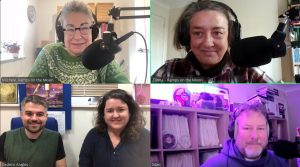
Jake and Jess chat about the transformations they made the moment they joined the Change Programme. They talk about asking the right, and sometimes difficult, questions, and challenging systems and structures that have been in place for years at Eastern Angles. With much more planned for the rest of their time on the programme, and beyond, this honest and open conversation gives listeners a real-time understanding of how they pivoted their organisation within months. Listen below.
Lincoln Arts Centre – Ben Anderson and Holly Cox
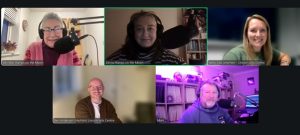
With thanks to all this year’s change partners
Participation in the Change Programme gives your organisation access to a rich programme of monthly workshops, discussions, and training for senior leaders; personalised mentoring and guidance from Ramps on the Moon and our partners People Make It Work; and the opportunity to work alongside a cohort of organisations at every stage of embedding anti-ableism in the performing arts.
“The most enriching experience I’ve had for a long time.” Sarah Crabtree – Royal Ballet and Opera
“Ramps on the Moon is the gold-standard; we’re delighted to be part of their cohort” – Rowan Rutter, CEO, City of London Sinfonia
To find out more visit our Change Programme page HERE
Michèle asks the question: ‘Does the word “Access” belong in the Social Model of Disability?’
There’s something that doesn’t sit comfortably with me any more about the word “access”. I don’t like the implication that, as a disabled person, I am being given something. I dislike even more the accompanying sense that you, as an organisation, are doing something good, something extra.
It seems to me that “providing access” ignores the reality that at some point in the past (last year, last century, half an hour ago) someone made a decision to build a barrier into the environment that makes it difficult or impossible for me to function in the way I need to. If we start with the idea of barriers, then removing them is not “providing access”, it’s reversing somebody’s bad decision. Sounds pedantic but I think it’s really important, because only then will we start thinking about not designing environments that have barriers built into them.
All the while we are content with “providing access”, we’ll continue to design things the way they have always been designed and then find ways to create access. We will forever be in a game of retrofitting solutions, and those solutions will always be more expensive and less effective than not building in the barriers in the first place.
So, am I suggesting that we stop using the word “access” altogether? I don’t think so. At least not yet and at least not in most contexts. I think we have to be pragmatic: people generally understand the word, and it’s what most disabled people will click onto to find the information we need when we’re using a website to plan a trip or an outing.
However, maybe those of us who work in the cultural sector should stop using it when we’re having conversations at a strategic level, in our planning and reviewing. Maybe, we should develop the discipline of talking about removing barriers because that reminds us of where the responsibility for disabling people actually belongs, and it challenges the idea that the way things are is just somehow a given over which we have no agency.
A Framework for Anti-Ableist Organisations
The Marketing Society claims companies who demonstrate disability confidence achieve 28% higher revenue, double the net income and 30% higher economic profit margins than those who do not.
HARD FACTS:
- £2 Billion per month is lost by businesses ignoring the needs of disabled people.
- 73% of disabled customers experience barriers on more than 25% websites.
- £163 Million per year is lost in the entertainment sector due to poor access for Disabled People.
The Ramps on the Moon framework supports cultural leaders to work towards an Anti-Ableist organisation.
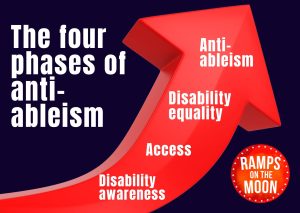
this framework has been created by Ramps on the Moon to:
- Set out the basic principles for becoming an anti-ableist organisation
- Enable you to locate yourself on your journey to anti-ableism and thereby plan for progression
- Support leaders to embed anti-ableism in their organisations and practice
- Promote discussion of anti-ableist practice within the cultural sector
- Reflect on examples of anti-ableist practice
Ramps on the Moon Podcast – Season One and Two

If you haven’t dived in yet, now is the moment! Michèle takes the Ramps on the Moon podcast straight into the engine room of mainstream theatre. Across fourteen bold and brilliant episodes, she sits down with actors, directors, producers and chief executives to uncover the joys, the tensions, the breakthroughs and the lessons in placing disabled people at the centre of cultural organisations.
Michèle shares the realities of the ‘now’ and what the future can hold for disability equality in the arts with Anti-Ableism weaved into every part of an organisation.
14 Episodes right HERE
This podcast is produced and managed by Podtalk UK

Welcome to the Dilemma Desk!
Your space for the bumps, scrapes, difficult conversations and barriers that come with embedding anti-ableism into your organisations. No problem is too tricky, no frustration too small. Here, we tackle the dilemmas that trip you up and offer you insights and solutions to help you move forward.
Let’s get going. We won’t publish your name or organisation – it’s all anonymous!
Contact us HERE with your dilemma
This is a brand new thing! So we’re starting without any dilemmas from you all – but Michèle has written a dilemma she is frequently asked for advice on – and for you to get a flavour of how she might respond.
Dilemma Desk 1:
Dear Ramps on the Moon
I work in a large building-based arts organisation; we’re lucky since we’re pretty financially stable and resilient. BUT I’m really struggling to get anyone in senior leadership to take access issues seriously. I get a variety of arguments: we haven’t got the budget, we don’t get any disabled people in anyway, it will put off our core audience, we’ll do it once we’ve completed the capital project. Honestly, my experience is that there’ll always be a ‘reason’ not to spend time and money making sure we’re doing what we can to welcome disabled audiences – and don’t get me started on disabled people actually working in the organisation!
Any advice would be brilliant. Thanks.
RW
Dear RW
It’s a little frustrating only to have a limited amount of space to respond to your question, but I’ll do what I can to summarise what might be 5 useful starting points, though they won’t all necessarily be applicable so you might need to choose relevant ones, and of course, amend these tips so they apply to your situation:
Identify your allies in the organisation and look for small actions you can take, things that will make a difference but won’t use significant resource; you could even gamify it.
Ask questions about disability equality and about the implications of decisions for disabled people at any and every opportunity you get (as well as some opportunities you create!). Question everything. Don’t forget that useful one word question, “Really?”, question assumptions, question the way things have always been done, just ask questions.
Get confident with your advocacy arguments and bring them into conversations: for example
The stats around disabled people. I simply don’t believe that you don’t get any disabled people into your building(s); are they getting what they need when they visit? How do you know?
The scale of the Purple Pound;
The organisational risk of not meeting your legal duties under the Equality Act (2010). And don’t forget that your duties to audiences and participants are anticipatory;
The cultural and artistic benefits of having an exciting mix of people around your organisation – for example, board, volunteers, staff, freelancers, visiting artists, audiences, participants.
Make sure there’s a working feedback mechanism so that front of house staff can report good and bad experiences that disabled people have at your organisation. Then find a way of telling that story to senior leadership.
Go back to who you say you are as an organisation or company and look for examples of how you do who you say you are, and for examples of inconsistency.
I’m not suggesting any of this is easy, which is why you need your allies and it will take time, but in summary: keep asking the questions, keep gathering the feedback data, and keep arguing for the value of developing disabled audiences, artists and staff.
Michèle

Check out our Resource Hub, packed with useful advice, tools, videos and stories from our founders on the legacy of Ramps on the Moon.

Thank you for taking the time to read The Shift – we’d love your feedback and look forward to bringing you another edition soon.
Contact us HERE for general enquiries and feedback
Find out more about our Consultancy and Training
Email: info@rampsonthemoon.co.uk for more information
DISCLAIMER: The information in this newsletter is provided for general guidance only and may be subject to change. No responsibility is accepted for any actions taken based on its content.