What happens when we stop talking about disability equality as something the arts need to ‘do’ and start thinking about it as something that can change how we work, create, lead and collaborate?
That question runs through of the Ramps on the Moon podcast.
Across six conversations, Michèle Taylor MBE, Director for Change at Ramps on the Moon, talks to artists, leaders, makers and performers about their experiences of the cultural sector, the changes they have seen, and the changes they still want to see.
There is a sense throughout the season that things are moving. More disabled artists are working across the sector. More conversations are happening. More organisations are thinking differently about access, leadership, collaboration and representation.
But progress doesn’t mean the work is finished.
As Michèle puts it, the podcast is a place to get curious about ableism in the arts: to listen to people who are challenging inequity, explore their experiences and ideas, and ask what might be possible.
And the conversations in Season 3 do exactly that.
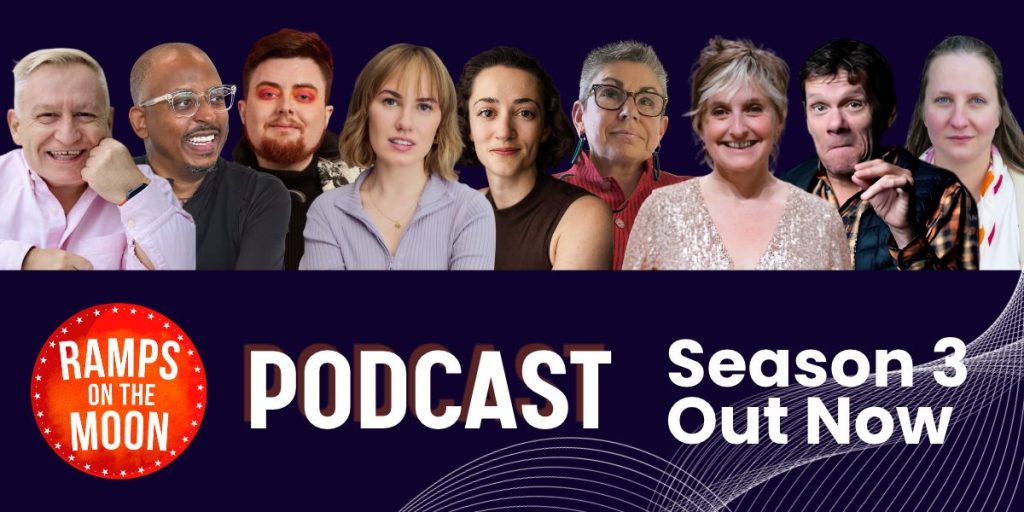
Left to Right: Simon Minty, Christopher Samuel, Jamie Hale, Lucy Thorburn, Natalie Kimmerling, MichèleTaylor MBE, Claire Hodson, Jamie Beddar and Jen Toksvig
Taking risks and making space
The season opens with artist Christopher Samuel, talking about taking risks, telling stories and the importance of collaboration.
There is a sense here of the artist as someone who doesn’t simply work within the structures that already exist but asks what else might be possible. What happens when we make room for different ways of creating? When collaboration is not an afterthought but part of the creative process itself?
Who has the power to change the room?
Jamie Hale is Director of CRIPtic Arts; Michèle’s conversation with them explores dismantling hierarchies and pushing the margins.
For Jamie, changing the arts means looking closely at where power sits and who gets to make decisions. It means questioning the hierarchies that can become so familiar that we stop noticing them.
The question isn’t simply who is allowed into the room. It is also who has influence once they get there.
What does leadership look like when it is shared?
That question of power and structure continues in the conversation with Claire Hodgson and Jamie Beddard, founders of Diverse City.
Diverse City has spent two decades developing work that places equality at the heart of its practice. Claire and Jamie talk about their shared leadership, collaboration and the ways in which different perspectives can strengthen an organisation.
Their experience also brings a useful honesty to the idea of progress.
Things can change significantly and still not be good enough.
There are more disabled artists working. There are organisations doing important work. There are initiatives that have helped change the landscape. And yet disabled artists can still arrive at major venues to find that basic access has not been considered.
For Claire and Jamie, anti-ableism isn’t something that sits separately from the work. It needs to become part of an organisation’s DNA, while remaining open to challenge, reflection and learning.
That tension is important.
How do we make anti-ableism part of everything we do, without losing sight of the barriers that still exist?
Rebel, leader, change-maker
With Simon Minty, the conversation moves into leadership and the possibility of being a rebel while also working within systems.
What does it mean to drive change rather than simply respond to it?
The season repeatedly returns to the idea that change can come from many places. From artists. From leaders. From collaborators. From people prepared to ask awkward questions. And from people who are willing to challenge the way things have always been done.
That doesn’t mean everyone has to occupy the same role. It means recognising that change is collective.
Connection over Control
For Jenifer Toksvig, the conversation takes a different route.
Their approach to storytelling places connection ahead of control, captured beautifully in the episode title: “I put the story last.”
It opens up another way of thinking about creative practice. About listening. About relationships. About what can happen when we allow the work and the people making it to shape the process rather than trying to control every outcome.
There is something quietly radical in that.
If changing the arts means changing how we work with one another, then connection matters.
“Am I here because I'm good, or because I ticked a box?”
The final episode brings the season’s questions into sharp focus.
Actors and puppeteers Natalie Kimmerling and Lucy Thorburn talk openly about their experiences of working in theatre, including the uncomfortable question of whether they have been offered opportunities because of their skills or because an organisation needs to meet a particular idea of representation.
It is a question that is rarely voiced so openly.
They also talk about the practical realities of working as disabled performers, from access and adaptations to the time and resources needed to make those adaptations possible.
But there is joy here too.
There is the joy of performing, of collaboration, of rehearsal rooms and of seeing another disabled person on stage and recognising something of yourself.
Lucy talks about the impact Natalie has already had on her simply by being there, working, making and showing what is possible.
That may be one of the most powerful things about change: sometimes we don’t know who we are making the way easier for.
The conversation continues…
Together, these six episodes reflect a cultural sector in movement.
There is real change happening. There are more disabled artists, more ambitious work, more conversations about power and representation, and more people questioning structures that once seemed immovable.
But Season 3 doesn’t suggest that we have arrived. Far from it!
The conversations are curious rather than complacent. They celebrate progress while continuing to ask difficult questions. They recognise the work that has been done while asking what still needs to shift.
And as Michèle says, that is where anti-ableism comes in – It is about more than access. It is about looking at the structures, cultures and assumptions that shape who gets to participate, create, lead and belong. And it is about recognising that change is not something one organisation, one artist or one movement can achieve alone.
The anti-ableist movement is growing. The conversation continues.
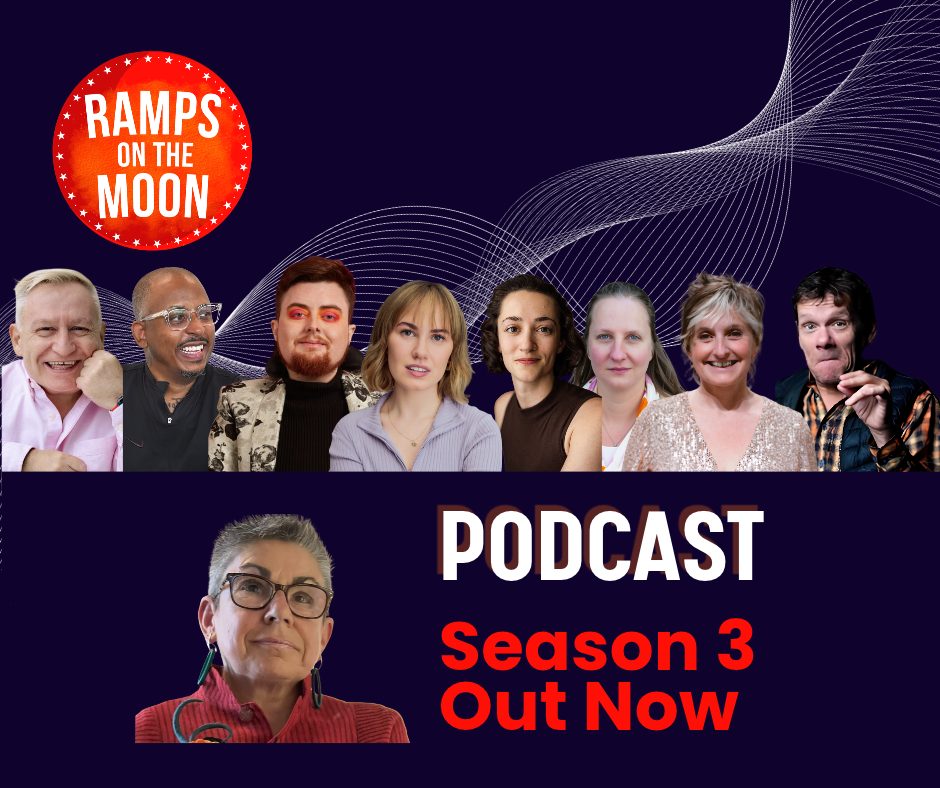
Listen to Season 3 of the Ramps on the Moon podcast, with Episodes 15 – 20 available now. Each episode is available with a full transcription.
Take me to The Ramps on the Moon Podcast
Join the Movement page and Subscribe to The Shift
Published by Zanna Hornby, for Ramps on the Moon, Oct 2026